
Your website shows up on Google. Good. But when someone asks ChatGPT for the "best headless development agency in Europe" or asks Perplexity "which CMS should I choose for a B2B e-commerce," does your brand appear in the answer?
Want us to do it for you? See our SEO service
If the answer is no (or you don't know), you have a problem that grows every month. We measured it in our own house before writing this: querying kiwop.com's Search Console through the API, we found 31,412 impressions across 2,513 AI-related searches in just 90 days, almost all of them in positions 40 to 90. Translation: people are already asking, we already graze the answer, and we're not capturing it yet. It happens to almost everyone, and that gap is exactly the territory of GEO.
This is the complete guide. Long on purpose, because we want it to be the reference you can save and come back to. If you only have a minute, start here.
The Essentials in 60 Seconds
- GEO (Generative Engine Optimization) and AEO (Answer Engine Optimization) are the discipline of getting AI engines (ChatGPT, Gemini, Perplexity, Copilot, Google's AI Overviews) to cite or recommend your brand when someone asks a question. SEO puts you on a list of ten; GEO turns you into the answer.
- It doesn't replace SEO. It complements it. The same well-crafted content works for both, with different rules.
- AI engines choose whom to cite based on five signals: content freshness, citable structure, brand mentions in external sources, proprietary, verifiable data, and technical accessibility for their crawlers.
- What moves the needle most isn't a trick, it's having something the model can't invent: your own data, cases, and judgment. That is also your competitive moat.
- Start with a 30-minute audit (step by step below), set a baseline, and repeat it every month.
What GEO and AEO Are, and How They Differ From SEO
Three acronyms that overlap and are worth separating:
SEO (Search Engine Optimization) optimizes your content to appear in Google's results: the classic ten blue links. You compete for position on a list.
AEO (Answer Engine Optimization) optimizes your content so that answer engines cite you as a source or recommend you when someone asks a question. The focus is the direct answer: featured snippets, AI Overviews, Perplexity's response.
GEO (Generative Engine Optimization) is the broader term and the one that's taking hold. It covers all optimization for generative engines: not just being cited in a one-off answer, but getting the model to associate your brand with a topic and reproduce it across its generations. In practice, GEO and AEO chase the same goal, and we'll use both terms throughout the guide.
The underlying difference with SEO is simple: in SEO you compete to be on a list, in GEO you compete to be the answer. An AI engine doesn't read your meta title or count your keywords. It reads context, evaluates authority, looks for verifiable data, and decides whether your content deserves to be cited.
They aren't mutually exclusive, they reinforce each other. A BrightEdge study of 500,000 queries found that brands optimized for AI engines appear in 18% of relevant responses, compared to 3% for non-optimized ones. Doing GEO or not is a 6x factor in visibility.
The Numbers That Justify Investing Now
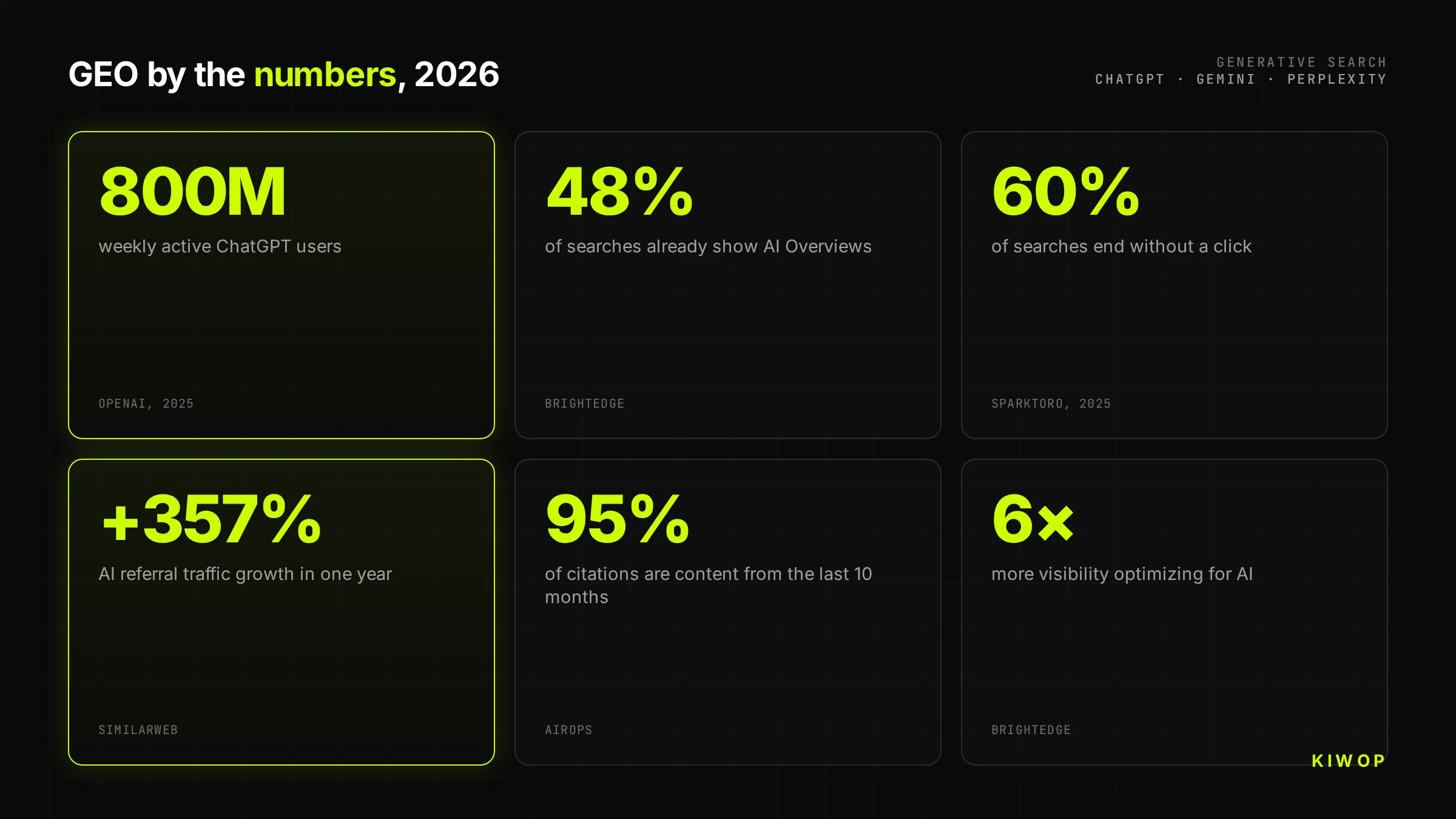
Before getting into the how, the data that explains the why:
- ChatGPT surpassed 800 million weekly active users in October 2025 (Sam Altman, OpenAI) and keeps growing. Gemini exceeds 400 million monthly.
- Google's AI Overviews now appear in 48% of the queries monitored by BrightEdge, nearly double a year earlier.
- 60% of Google searches already end without a click (SparkToro/Datos, 2025). The user gets the answer on the results page itself or in an AI summary.
- Referred traffic from AI platforms grew 357% year over year (Similarweb, June 2025), with 1.13 billion referred visits in a single month. And that visitor converts better than average traffic, because they arrive with the decision half made.
- 85% of companies plan to increase their investment in AI search optimization in 2026 (Conductor).
The market is moving. The question isn't whether GEO matters, but how much ground you lose while you're not working on it.
How AI Engines Decide What to Cite
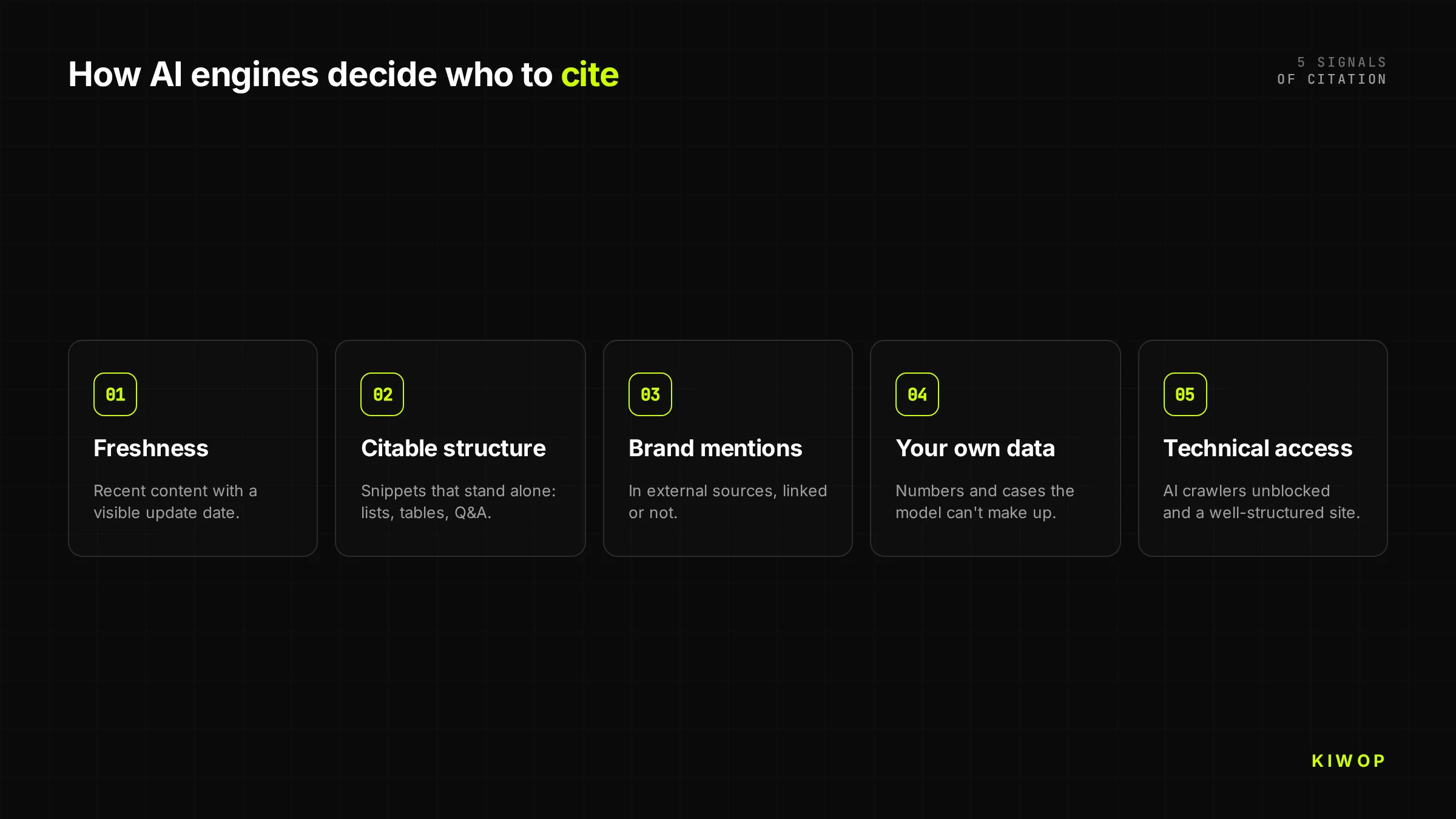
The LLMs (large language models) powering these engines don't work like Google. They don't have an index with numbered positions. They generate the answer by synthesizing information from several sources, and many of them (Perplexity, AI Overviews, ChatGPT with search) build it with a technique called grounding, or RAG: they retrieve documents live and write the answer from them, citing where each claim came from. Winning at GEO means winning that retrieval and citation process. These are the signals that decide it.
Content Freshness
The most decisive factor. An AirOps study of more than 4,000 pages cited by ChatGPT revealed that 95% of citations come from content published or updated within the last 10 months. Pages with a visible last-updated date receive 1.8 times more citations.
If your latest article is from 2023, AI engines are ignoring it.
Structure and "Citability"
LLMs prefer content they can fragment: a paragraph that answers a specific question, a list with clear steps, a comparison table with data. According to a SEOMator analysis of 177 million AI citations, list-format articles account for 32% of all citations, and the question-and-answer format is the top performer.
You don't have to write everything as a list. But each section should stand on its own: if an AI engine extracts only that paragraph, does it make sense by itself? That's the citability test.
Brand Mentions in External Sources
Here the difference with SEO is notable. In traditional SEO, backlinks count. In GEO, unlinked brand mentions count too. When a publication, an industry directory, or a LinkedIn article mentions your company by name, LLMs register it as an authority signal.
AI engines build an entity graph. If your brand consistently appears associated with a topic ("Kiwop" + "headless development" + "Astro"), the model reinforces that association and reproduces it in its answers.
Original Data and Verifiable Experience
Content that says "SEO is important" adds nothing the model doesn't already know. Content that says "we implemented this strategy with an e-commerce client and organic traffic grew 47% in four months" is citable, because it provides a data point the model can't invent.
AI engines prioritize content with proprietary statistics, real cases, and documented results. It's the algorithmic version of Google's E-E-A-T (Experience, Expertise, Authoritativeness, and Trustworthiness), and LLMs apply it even more strictly, because they need concrete data to generate concrete answers.
Technical Accessibility
Your website has to be readable by AI crawlers (GPTBot, PerplexityBot, ClaudeBot, Google-Extended, among others). If you block them in robots.txt, you're invisible. And sites with good structure (hierarchical headings, schema markup, fast loading, server-rendered content) are much easier for models to process.
GEO Audit: How to Know Where Your Brand Stands Right Now
Before optimizing, you need a diagnosis. This audit takes 30 minutes and gives you a clear map of your situation.
Step 1: Ask About Your Industry
Open ChatGPT, Gemini, and Perplexity. Ask the questions a potential client would ask:
- "What's the best [your service] agency in [your area]?"
- "Which company would you recommend for [problem you solve]?"
- "Compare the best options for [your product or service category]"
Note whether you appear, where in the answer, and what they say about you.
Step 2: Ask Directly About Your Brand
- "Do you know [your brand]? What do they do?"
- "What are people saying about [your brand]?"
- "Is [your brand] a good option for [specific use case]?"
If the engine doesn't know you, you already know you have work ahead. If it knows you but says something wrong or incomplete, you need to fix the sources it draws from.
Step 3: Compare With Competitors
- "[Your brand] versus [competitor]: which is better for [use case]?"
- "Alternatives to [competitor] for [need]"
This shows you whether AI engines position you as a viable alternative or don't even mention you.
Step 4: Use Perplexity to Verify Sources
Perplexity is especially useful because it shows the exact sources for each claim. Search for your brand there and you'll see which sites it pulls your information from. Those sources are the ones you need to strengthen, or create if they don't exist.
Step 5: Document and Set Your Baseline
Create a document with where you appear, where you don't, what they say, which sources they cite, and how you compare to your direct competitors. That's your starting point. Repeat the audit every month to measure progress. Without a baseline there's no measurable improvement, only gut feeling.
12 Concrete Actions to Improve Your GEO
1. Create Content That Answers Specific Questions
Not "Digital Marketing Guide." Yes to "How to Cut Customer Acquisition Cost by 40% With Algorithmic SEO." AI engines look for answers to concrete questions, and your content has to be that answer.
Every article should target a question a real user would ask ChatGPT. If you can't phrase that question, the content is too generic for GEO.
2. Write "Answer-First": the Answer Before the Context
LLMs extract better when the answer comes in the first lines of a section, not buried after three paragraphs of introduction. Open each section with the conclusion and then develop it. An "essentials" block at the top of the article, like the one in this very guide, multiplies your chances of being cited.
3. Implement Rich Schema Markup
AI engines process content with structured metadata better. It's not optional, it's infrastructure:
- Article with author, datePublished, and dateModified
- Organization with name, logo, location, and social profiles
- Person for authors, with credentials and a LinkedIn link
- FAQPage for frequently asked questions sections
- HowTo for step-by-step guides
Schema doesn't only help Google. It helps any system that processes your site programmatically, LLMs included.
4. Earn Mentions in External Sources
LLMs build authority from distributed mentions. It's not enough for your own site to say you're an expert, you need others to say it:
- Publish as a guest author in your industry's media
- Keep profiles updated on professional directories (Clutch, GoodFirms, G2)
- Respond to journalists and bloggers covering your area
- Take part in podcasts and webinars (transcripts get indexed)
Every mention is a vote of confidence that models register.
5. Keep Your Google Business Profile Updated
Google Business Profile is still one of the sources LLMs consult for local and company information. Recent photos, correct hours, precise categories and, above all, authentic customer reviews. AI engines weigh ratings as a trust signal.
6. Publish Content With Proprietary Data
Internal statistics, project results, industry benchmarks, customer surveys. AI engines prioritize data they can't find anywhere else. If you publish an original, verifiable data point, you become a primary source, and primary sources get cited.
An example: instead of "SEO improves conversions," say "in a project with a fashion e-commerce client we optimized the content for transactional intent and organic conversions rose 34% in the first quarter."
7. Keep an Active LinkedIn Presence With Authority Content
LinkedIn is one of the sources LLMs index often. Regularly publishing professional content (trend analysis, lessons learned, summarized cases) reinforces the association between your name, personal and company, and your area of expertise.
It's not about posting for the sake of posting. It's that when an LLM looks for information on your specialty, it finds your name tied to relevant content across several platforms.
8. Make Sure Your Site Is Technically Accessible to LLMs
AI engines send specific crawlers. Review your robots.txt and check that you don't block GPTBot, PerplexityBot, ClaudeBot, or Google-Extended.
Beyond that, the technical fundamentals matter: loading speed, clean hierarchical headings (one H1, then H2, then H3), server-rendered content that doesn't depend on client-side JavaScript, and semantic URLs. According to AirOps, descriptive URLs of 5 to 7 words earn 11.4% more citations than generic ones.
9. Publish an llms.txt File
It's the equivalent of robots.txt for language models: a file at the root of your domain that summarizes what your site is and links to your key pages in a clean format, easy for an LLM to process. It's still a young standard, but it costs little and serves your content up on a platter. We already publish one on kiwop.com.
10. Implement WebMCP So AI Agents Can Interact With Your Site
The next level. WebMCP is a standard proposed by Google and Microsoft that lets AI agents operate directly with your site: search products, request a quote, filter results, without simulating clicks.
It's no longer just visibility (being cited), it's functionality (agents being able to operate with you). Whoever implements it early will have an edge in the ecosystem of autonomous agents that's already emerging. We develop it in our guide to LLM integration.
11. Create Author Pages With E-E-A-T
LLMs look for author authority signals, not just domain signals. Every person who publishes on your site should have an author page with a professional photo, a bio with experience and credentials, a LinkedIn link, a list of published articles, and areas of specialization.
It's not vanity. It's a direct signal that the content is written by someone with real knowledge, not a machine on autopilot.
12. Monitor Your Presence in AI Engines Every Month
GEO isn't set once and forgotten. Models update, sources change, and the competition moves. Set a monthly routine: repeat the audit, compare against the baseline, spot new questions where you should appear, watch for changes in what's said about you, and adjust. Pages that aren't updated every quarter are 3 times more likely to lose citations in ChatGPT (AirOps, 2025).
GEO for Product, Service, and Local Business Pages
The guide works for any site, but there are nuances depending on what you sell.
E-commerce and product. Shopping agents already compare products for you. Prioritize listings with structured data (Product and Offer schema), specs in a table, up-to-date availability and price, and real reviews. A model comparing "the best trail running shoes under 120 euros" needs data it can extract and cross-check, not a carousel of images with no text.
B2B services. Here the winner is content that explains decision criteria: honest comparisons, cases with results, and service pages that answer "who is this for?" and "when does it make sense?". B2B buyers ask the AI before filling out a form.
Local business. Google Business Profile, reviews, NAP consistency (identical name, address, and phone everywhere), and mentions in local directories. LLMs lean heavily on these sources for answers with geographic intent.
How to Measure GEO: KPIs and Tools
You can't improve what you don't measure, and GEO has its own metrics, different from those of classic SEO:
- Citation rate: the percentage of relevant answers your brand appears in. It's the equivalent of average position, but in AI answers.
- Share of voice: your presence versus your competitors' across a fixed set of questions in your industry.
- Sentiment and accuracy: being cited isn't enough, what they say matters. An engine that describes you badly is a source problem.
- AI referral traffic: measure in your analytics the visits arriving from chatgpt.com, perplexity.ai, gemini.google.com, and the like. It's usually undervalued because many tools still don't segment it well.
To automate it there are emerging tools (Profound, Peec AI, Otterly, among others) that track your citations across the main engines. And don't underestimate the manual route: a sheet with 20 key questions, reviewed each month across the three main engines, already gives you an honest picture of your progress.
What Does NOT Work in GEO
Knowing what to avoid is as important as knowing what to do.
Keyword stuffing. LLMs understand semantics, they don't count repetitions. Saturating a text with the target keyword doesn't improve your GEO, it hurts it: it sounds artificial and models detect it.
Generic content copied from others. An Ahrefs analysis revealed that 67% of the pages most cited by ChatGPT are sources a marketer can't replicate (Wikipedia, government sites, academic institutions). The brands that earn citations do so with original content and proprietary data, not by repeating what already exists.
Optimizing only your site with no external presence. If your brand is only mentioned on your own site, LLMs don't consider it an entity with authority. You need distributed presence: directories, media, professional networks, review platforms.
Walls of text with no structure. A 3,000-word article with no headings, no lists, and no short paragraphs is hard to fragment. And what can't be fragmented can't be cited. Structure isn't decoration, it's functionality.
Blocking AI crawlers. It may seem contradictory, but some companies block GPTBot or ClaudeBot out of caution. If you want to appear in those answers, they need to be able to read your content.
AI-generated content with no human judgment. Publishing model text in bulk, with no proprietary data and no review, is the fast lane to irrelevance: it's exactly what the LLM already knows how to generate, so it has no reason to cite you.
GEO + SEO: The Complete Strategy
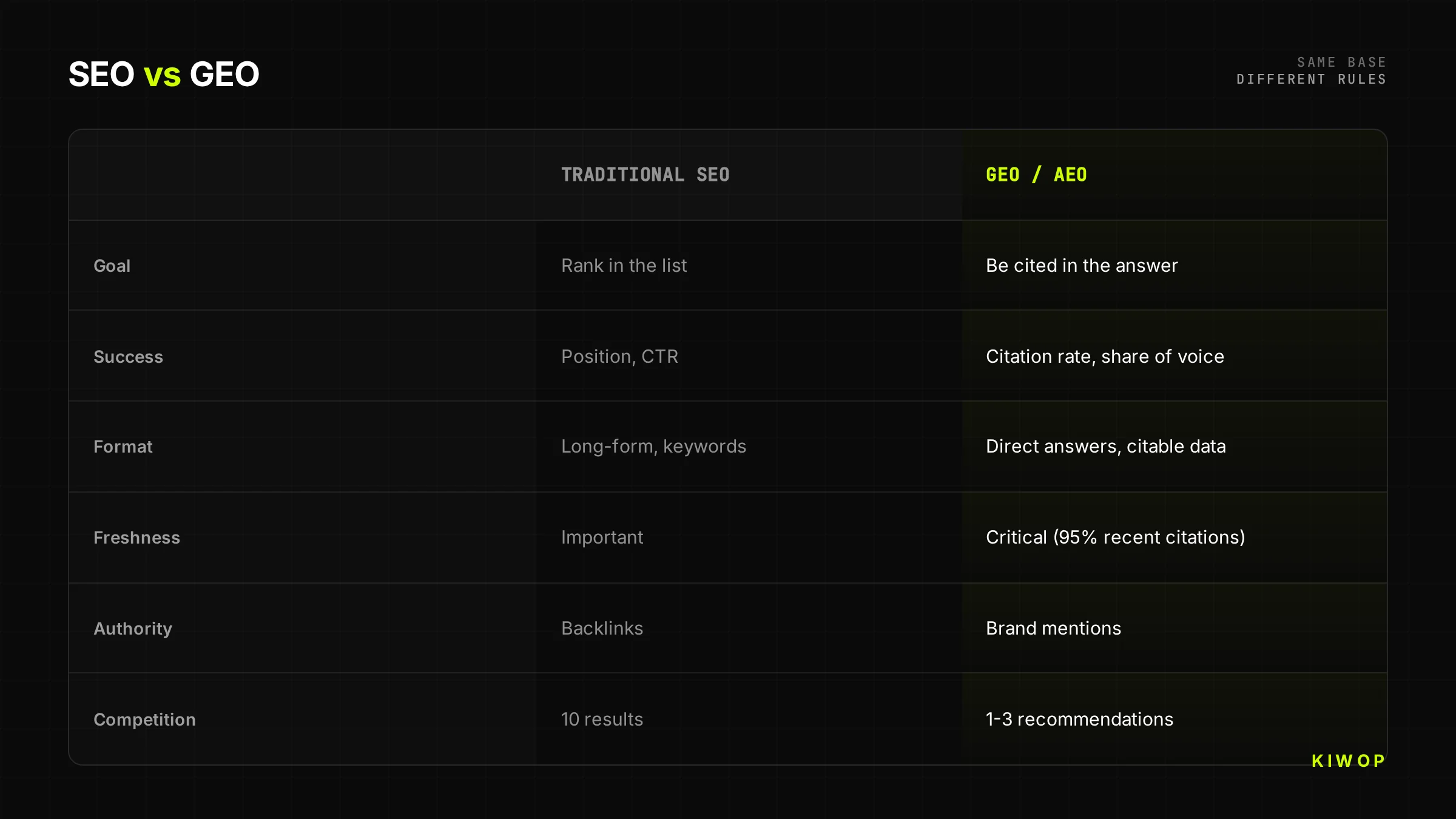
GEO doesn't replace SEO, it complements it. And the good news is that well-crafted content works for both.
BrightEdge data shows that the overlap between AI Overview citations and organic results has grown from 32% to 54.5% in 16 months. In other words, more than half of the content Google cites in its AI summaries also ranks in the top organic results. Doing good SEO puts you in position to be cited by AI.
But there's a key data point: 83% of AI Overview citations come from content that is NOT in the organic top 10. You can be cited by AI without ranking first on Google. GEO opens a door that traditional SEO doesn't have.
The practical difference: if you search "headless web development agency" on Google, you compete with ten results. If you ask ChatGPT, there are only one to three recommendations. Being there is worth far more.
- Objective. Traditional SEO: Rank in the results list. GEO / AEO: Be cited in AI answers.
- Success metric. Traditional SEO: Position, CTR. GEO / AEO: Citation rate, share of voice.
- Format. Traditional SEO: Long-form, keywords. GEO / AEO: Direct answers, citable data.
- Freshness. Traditional SEO: Important. GEO / AEO: Critical (95% of citations are recent content).
- Authority. Traditional SEO: Backlinks. GEO / AEO: Brand mentions (with or without a link).
- Competition. Traditional SEO: 10 results. GEO / AEO: 1-3 recommendations.
The optimal strategy is to do both in parallel. The same content, well-structured, with real data and demonstrable authority, works for Google and for ChatGPT. The difference is one of focus, not duplicated effort.
How We Do It at Kiwop
We're not writing this from theory. GEO is part of what we do with clients and on our own site.
Kiwop.com is built with a headless architecture (Astro + Payload CMS): server-rendered content, schema markup on every page, and clean semantic URLs. It's exactly what AI crawlers process best, accessible content that doesn't depend on client-side JavaScript. We don't block any AI crawler in our robots.txt, and we publish an llms.txt with the site map for models.
We work with data, not intuition. The figure this article opens with (31,412 impressions across 2,513 AI searches in 90 days) isn't a made-up example: we pulled it from our own Search Console through the API, which is exactly the kind of proprietary, verifiable data that makes content citable. We apply that same rigor to client projects: monitoring where AI cites you and working to improve it is part of our GEO service.
And there's a deeper layer. We run Kiwop on Nexo, our own AI brain, and that same system is the one we build for clients: their AI trained on their data, their history, and their judgment. Models are interchangeable (one today, another tomorrow), but the knowledge of your business isn't. That's why the best long-term GEO isn't a visibility trick, it's turning your operation into something the AI wants to cite because only you have it. We develop this in the article on your AI that's impossible to copy.
The reality is that most companies still haven't heard of GEO. That's not a problem. It's a window that will close once the competition catches up.
GEO/AEO Glossary
- GEO (Generative Engine Optimization): optimization to get generative AI engines to cite and recommend your brand.
- AEO (Answer Engine Optimization): optimization for answer engines. In practice, a synonym for GEO.
- LLM (Large Language Model): a large language model, like GPT, Gemini, or Claude, that generates text from a prompt.
- Grounding / RAG: the technique by which an engine retrieves documents live and writes the answer from them, citing the sources.
- AI Overviews: the AI-generated summaries Google shows above the classic results.
- Citation rate: the percentage of relevant answers your brand appears in.
- Share of voice: your presence versus the competition across a set of questions.
- E-E-A-T: Experience, Expertise, Authoritativeness, and Trustworthiness. Google's quality framework, which LLMs apply even more strictly.
- GPTBot, PerplexityBot, ClaudeBot, Google-Extended: the crawlers AI engines use to read the web.
- llms.txt: a file at the root of your domain that summarizes your site for language models.
- WebMCP: a standard that lets AI agents interact with your site, not just read it.
Frequently Asked Questions
What is GEO and how does it differ from SEO?
GEO (Generative Engine Optimization) is optimization to get AI engines like ChatGPT, Gemini, or Perplexity to cite or recommend your brand. SEO seeks position on Google's results list; GEO seeks to be the answer the AI generates. They complement each other, but the rules are different: GEO weighs freshness, citable structure, brand mentions, and proprietary data above keywords.
Are GEO and AEO the same thing?
In practice, yes. AEO (Answer Engine Optimization) focuses on answer engines and GEO is the broader term for all generative optimization. Both aim to get your brand into the AI's answers, so you can treat them as synonyms.
How do I get ChatGPT to recommend my brand?
With five levers: publish fresh, up-to-date content, structure it so it's easy to extract (direct answers, lists, tables), earn brand mentions in authoritative external sources, provide proprietary data the model can't invent, and make sure your site is technically accessible to AI crawlers. Start with the 30-minute audit in this guide to learn your starting point.
Has classic SEO stopped working?
No. SEO is still essential: more than half of the content AI cites also ranks well on Google. What's changed is that it's no longer enough. GEO adds a new path, because 83% of AI Overview citations come from content that isn't in the organic top 10.
How long does it take to see results?
It depends on your starting point and your brand's prior authority. The technical signals (schema, accessibility, freshness) can be applied in weeks. Building external mentions and entity authority is a matter of months. That's why it's worth measuring each month and comparing against your baseline, rather than expecting an overnight change.
Do I have to block AI crawlers to protect my content?
If you want to appear in those engines' answers, no. Blocking GPTBot or ClaudeBot in robots.txt leaves you out of their citations. Protecting sensitive content is done other ways (authentication, paywalled content), not by shutting the door on the crawlers that can recommend you.
Does GEO work for a local or small business?
Yes, and sometimes more than for a large one. For local business, your Google Business Profile, reviews, NAP consistency, and directory mentions carry a lot of weight. These are signals a small business can work on without a big budget, and they move the needle fast on answers with geographic intent.
How do I measure whether GEO is working?
With three metrics: citation rate (how many relevant answers you appear in), share of voice (your presence versus the competition), and AI referral traffic in your analytics. You can automate it with tools like Profound or Peec AI, or keep a sheet with 20 key questions that you review each month in ChatGPT, Gemini, and Perplexity.
Quick Checklist
If you take away just one thing from this guide, let it be this list. Save it and review it every month:
- Fresh content with a visible update date
- Answer before context (answer-first) in every section
- Rich schema markup (Article, Person, Organization, FAQPage, HowTo)
- Mentions in external sources (directories, media, guest posts)
- Google Business Profile updated and with recent reviews
- Content with proprietary data (cases, statistics, real results)
- Active LinkedIn presence with authority content
- AI crawlers allowed in robots.txt and llms.txt published
- WebMCP for direct interaction with AI agents
- Complete author pages with E-E-A-T
- Monthly measurement of citation rate, share of voice, and AI referral traffic
The Time Is Now
AI answer engines aren't the future, they're the present, with more than 800 million weekly users on ChatGPT alone. Every month without optimizing for them is a month of invisibility to a segment of customers who no longer search on Google the way they used to.
The good news: since GEO is still new territory, the competition hasn't moved. Whoever starts now will have an advantage that's hard to replicate once the market matures.
If you want to know where your brand stands in AI engines and what to do to improve your position, let's talk. The GEO audit we describe here is the first step, and the results are usually eye-opening.
Sources cited:
- Similarweb, "AI Referral Traffic to Top Websites" (July 2025), via TechCrunch
- Conductor, "2026 AEO/GEO Benchmarks Report" (November 2025)
- BrightEdge, "AI Overview Citations Study" and "AI Search Visits Surging in 2025"
- AirOps, "The Impact of Stale Content on AI Visibility" (2025)
- SparkToro/Datos, "State of Search" (Q2 2025)
- Ahrefs, "67% of ChatGPT's Top Citations Are Off-Limits" (2025)
- SEOMator, analysis of 177 million AI citations
- OpenAI, active user data (Sam Altman, October 2025)
- Proprietary data: kiwop.com Google Search Console, sc-domain property, 90-day window (2026)