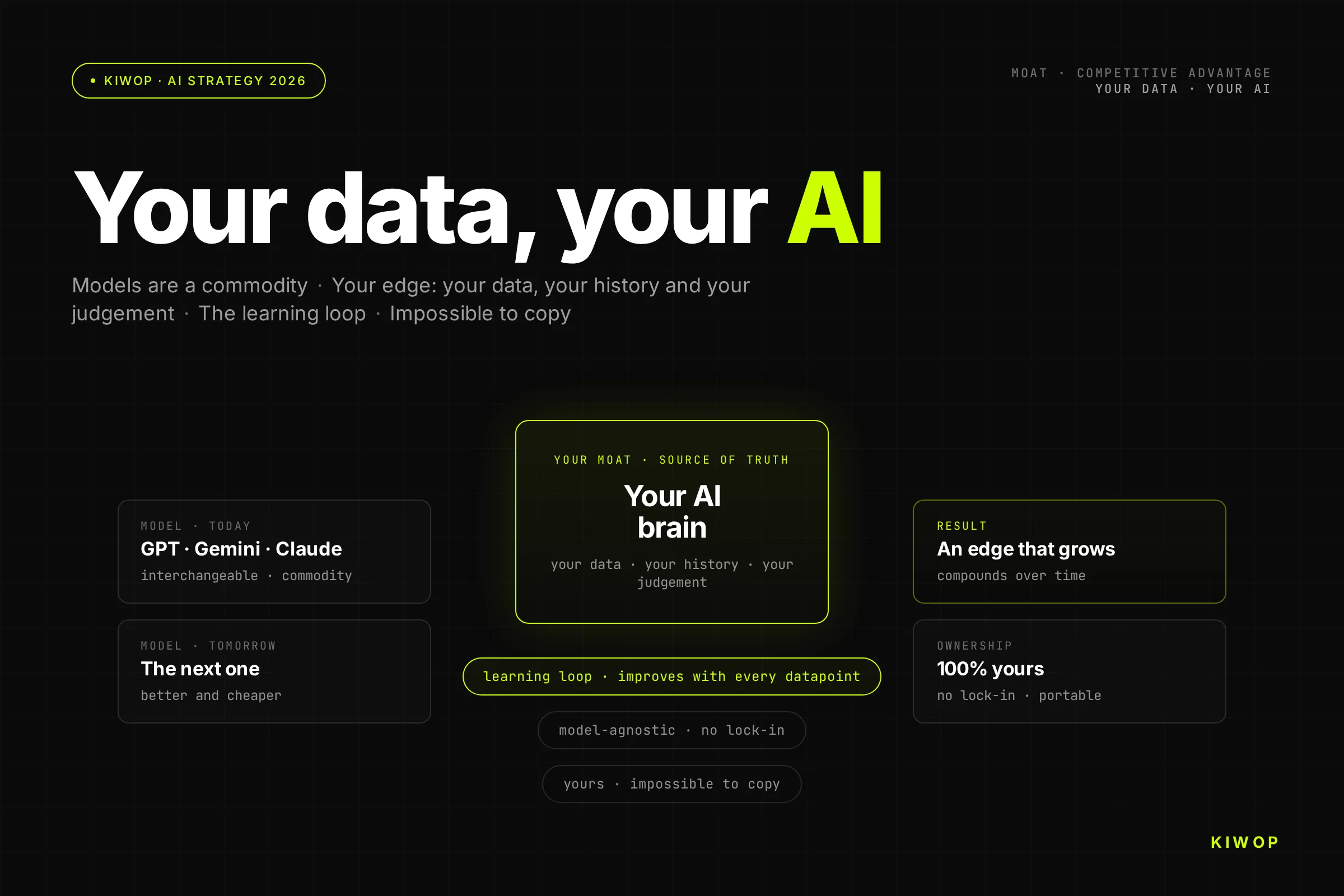
If your AI plan is "use ChatGPT like everyone else," you don't have an advantage, you have a subscription. The same one your competition has. The competitive advantage AI can give you isn't in the model you use, it's in what only you have: your data, your history, and the judgment you make decisions with. That's a moat, and it's the one thing about your AI strategy that no one can copy.
Want us to do it for you? See our AI Consulting service
This guide explains why, and how to build it.
The Essentials in 60 Seconds
- AI models are a commodity. Today you use one, tomorrow another that's better and cheaper. No one builds a lasting advantage on something their competition hires with a credit card.
- Your advantage is your data, your history, and your judgment. The knowledge of how your business works, built up over years, is what a competitor can't download.
- An AI moat turns that knowledge into a system that learns from your operation and improves with every data point. It's the difference between renting generic intelligence and owning yours.
- Watch out for lock-in. A moat is yours. If your "AI" lives inside a vendor's closed product, you haven't built a moat, you've stepped into someone else's.
- It's built in four moves: unify your data, codify your judgment, close the learning loop, and make sure the system is yours.
What a Moat Is, and Why AI Changes Everything
A moat (the strategy jargon Warren Buffett popularized) is a structural competitive advantage: something that makes your business hard to replicate. A strong brand, a network effect, a high switching cost, a patent. Without a moat, anyone with capital copies what you do and competes on price.
For years, technology was a moat in itself. Having the best software, the best website, or the best internal system set you apart. AI breaks that logic for an uncomfortable reason: the ability to generate software, text, analysis, or design has become abundant and cheap. What used to set you apart, everyone now has almost for free.
This scares a lot of people, and for good reason. But it has a much more optimistic reading. When the ability to build stops being scarce, value shifts to what's still scarce: the specific knowledge of your business. AI doesn't destroy moats, it changes where they are. And it puts them, for the first time, within reach of companies that could never afford a data department.
Why the AI Model Isn't Your Advantage
Here's the trap almost everyone falls into: confusing the tool with the advantage.
The frontier models (GPT, Gemini, Claude, and whatever comes next) are extraordinary and getting better. They're also a commodity. The cost per token has fallen year after year, brutally, and every few months a model appears that beats the last one. What looks like magic today is, twelve months out, the baseline everyone uses.
Think of it this way: if your competitive advantage is "we use the best AI model," you have three problems. First, your competition uses the exact same one, a click away. Second, the "best" changes every quarter, so your advantage expires on its own. Third, and the worst, you control nothing: you depend on a vendor's roadmap, prices, and decisions.
The conclusion is liberating. Since the model is interchangeable, it stops being where you compete. Pick the one that works best today, swap it when a better one comes out, and don't marry any of them. We call this being model-agnostic: the model is the engine, not the car. What sets you apart is everything else.
Your Real Advantage: Data, History, and Judgment
If the model isn't the advantage, what is? Three things you've been accumulating without realizing it, and that no competitor can download off the internet.
Your data. Every order, every support ticket, every campaign, every conversation with a customer. It's the record of how your market behaves with you, and it's unique. A generic model knows a lot about the world and nothing about your business. Your data is exactly what it's missing.
Your history. Not just what happened, but what worked and what didn't. The decisions you made, their results, the mistakes you no longer repeat. It's operational memory, and it's worth gold because it's expensive to build: it's paid for in years.
Your judgment. This is the hardest to copy and the most underrated. In your company there's knowledge that isn't written in any manual: why you say yes to this type of client and no to that one, how you sense a project is going to go wrong, what exceptions you make and when. At Wharton they call it tacit knowledge: the know-how that lives in your people's heads and usually walks out the door when someone leaves.
The great opportunity of AI isn't to replace that judgment, it's to capture it. To turn your team's tacit, scattered, fragile knowledge into an explicit system that doesn't leave with the person. That's what no competitor has: not your tools, your way of thinking about the business, executed at scale.
The Learning Loop: Why Every Data Point Makes You Stronger
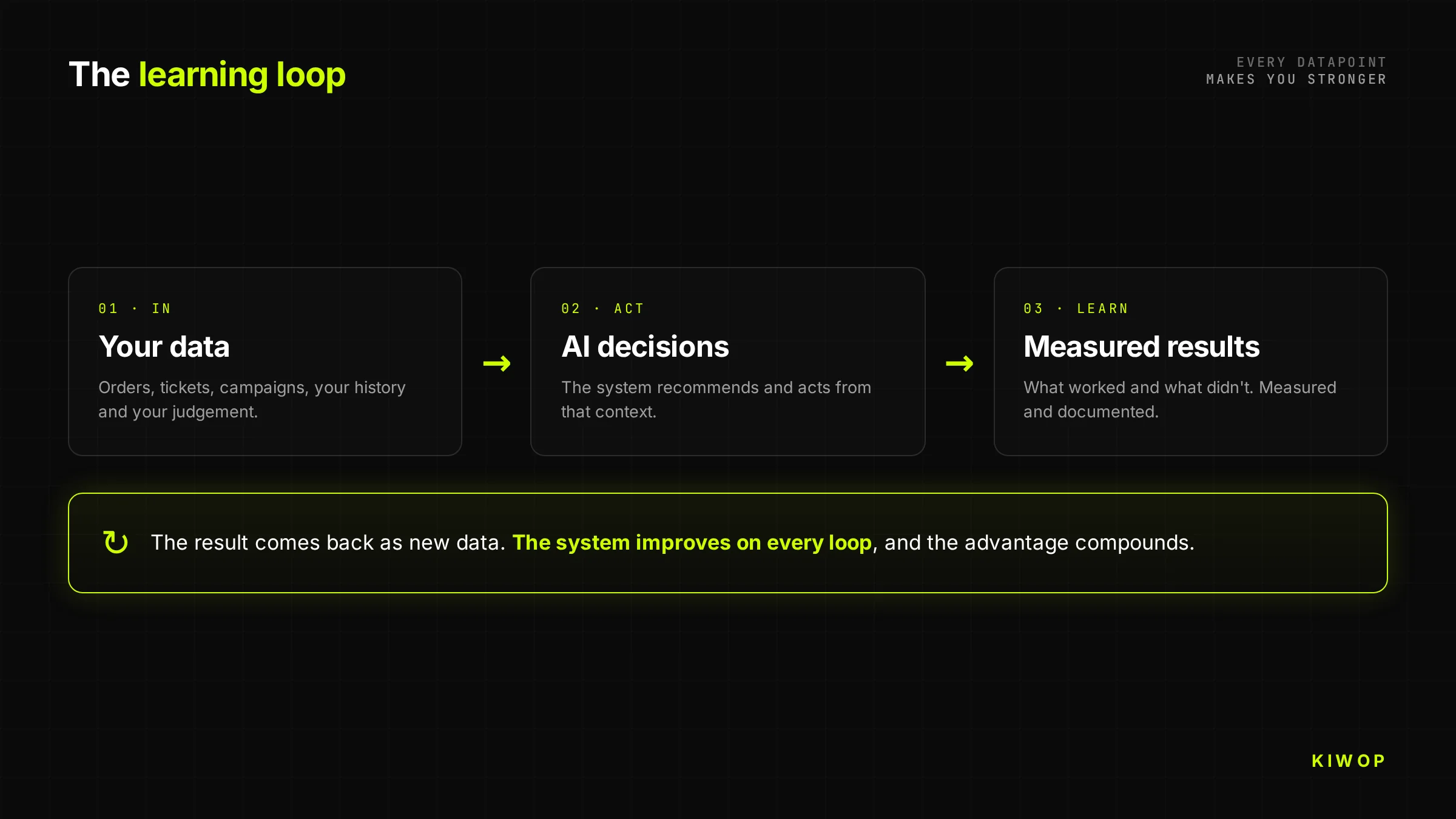
A static moat isn't a moat, it erodes. What turns your data into an advantage that grows is the learning loop.
It works like this. Your AI system makes decisions or recommendations. Those decisions produce results. The results are measured and fed back into the system as new data. The system improves. And because it starts from better data, it improves faster than someone starting from scratch. The advantage compounds, like interest.
Satya Nadella, Microsoft's CEO, sums it up in an idea he repeats often: the key isn't to use someone else's AI, it's to own your own intellectual property and your learning loop. Whoever controls the loop controls the advantage. Whoever only consumes someone else's model rents a capability their vendor can raise the price on, change, or hand to their competitor tomorrow.
The practical takeaway is clear: don't measure your AI progress by how many tools you've adopted, but by how much your operation learns from itself each month. That's the only indicator that translates into a moat.
Moat or Trap: The Lock-In Pitfall
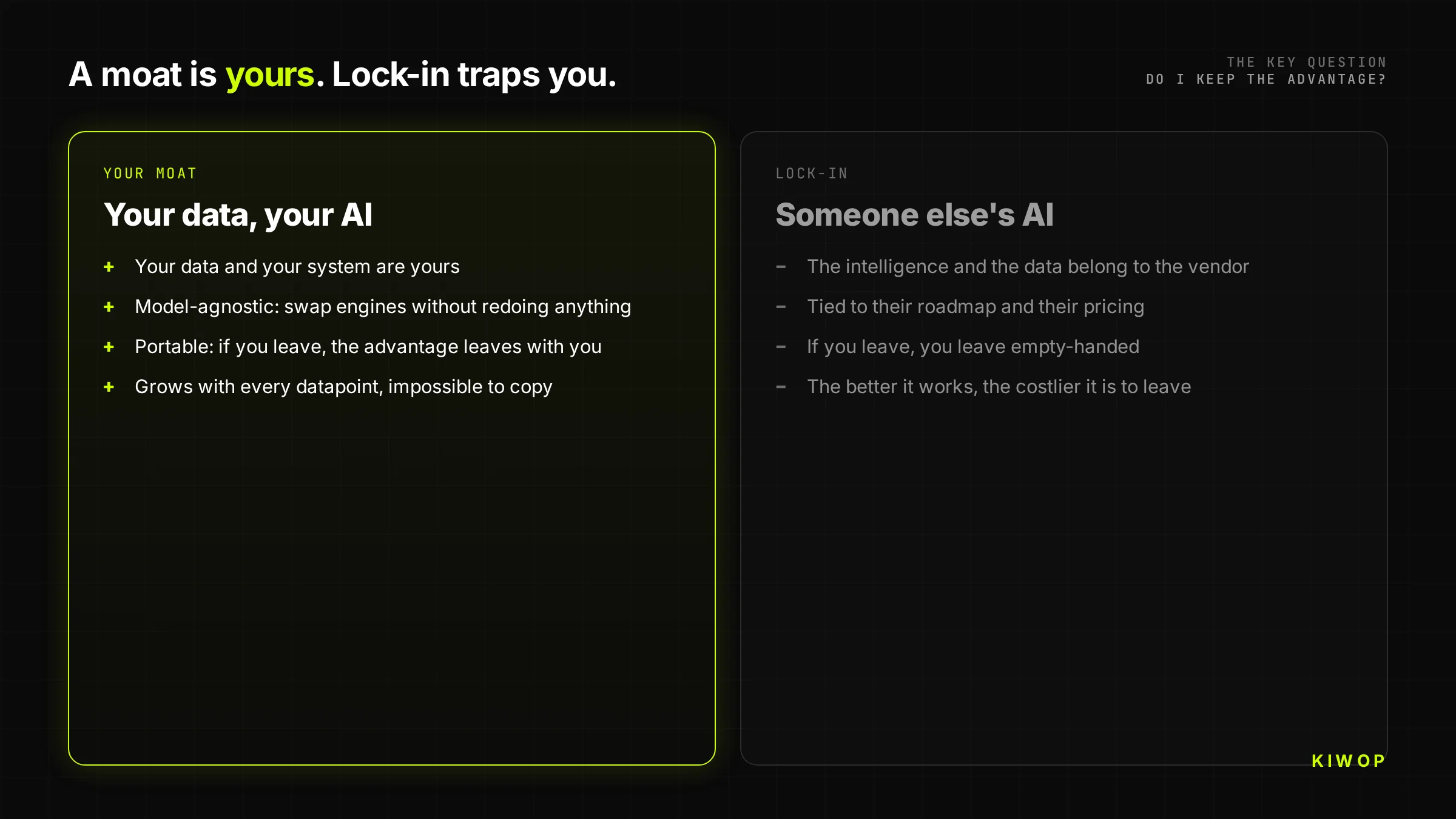
There's a huge difference between building your moat and stepping into someone else's.
When you adopt a closed AI tool (a SaaS that does something with AI for you), you get an improvement, sure. But the intelligence, the trained data, and the system belong to the vendor, not to you. If you leave, you leave empty-handed. That's not a moat that protects you, it's a trap that locks you in. And the better it works, the more expensive it is to leave.
A real moat has a property the trap will never have: it's yours. Your data is yours, the system that learns from it is yours, and if you switch technology vendors tomorrow, your advantage goes with you. That's the line that separates "we use AI" from "we have an AI." Anyone can have the first. The second can't be copied, because it's made of your business.
So when you evaluate any AI initiative, ask yourself a single question: if I take this elsewhere tomorrow, do I take the advantage with me or lose it? If you lose it, you're not building a moat.
How It's Built in Practice
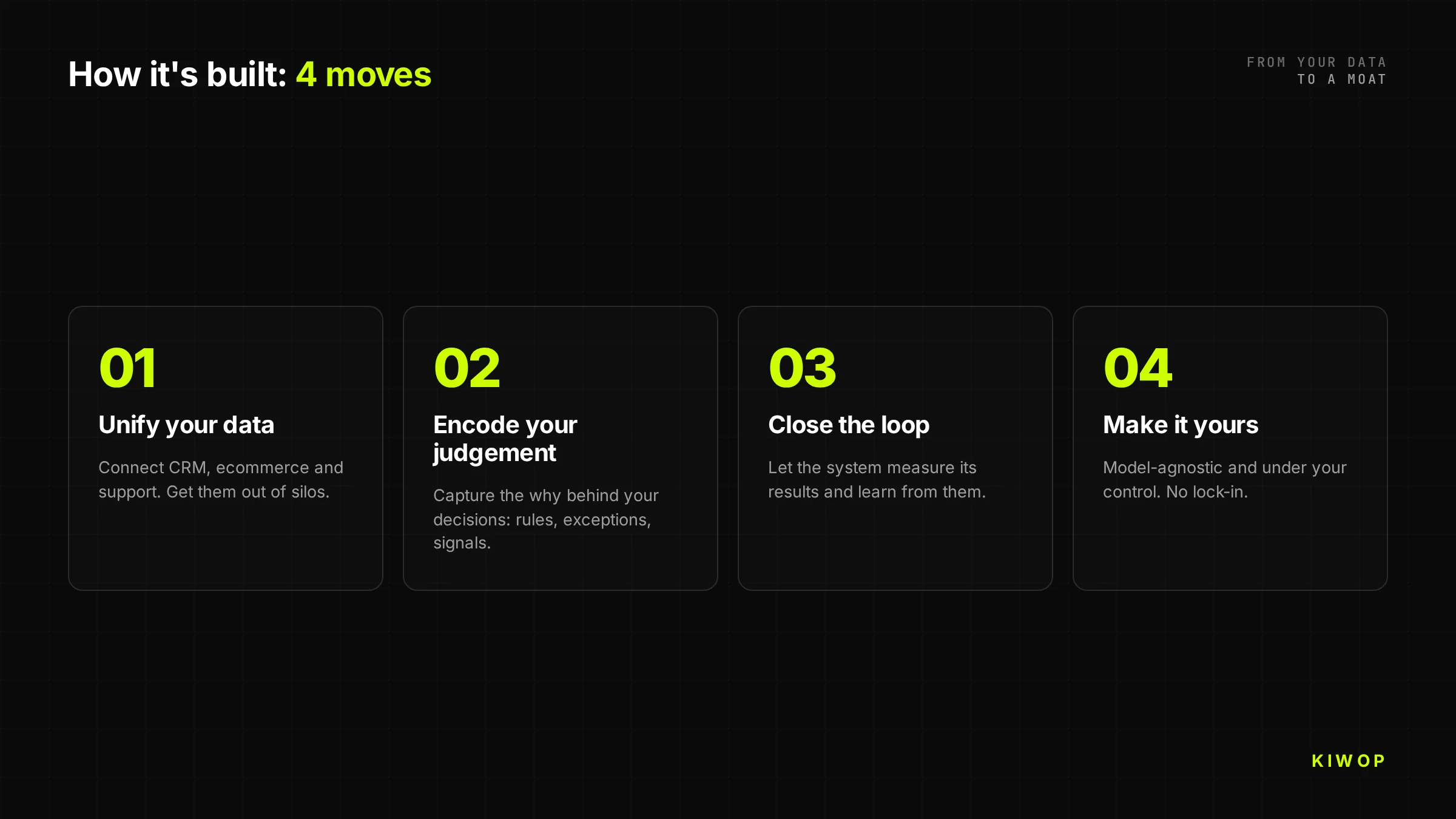
An AI moat isn't bought, it's built. And you don't have to be a multinational to start. These are the four moves.
1. Unify Your Data
The knowledge of your business is usually chopped up: the CRM on one side, the e-commerce on another, support in a third, and half the judgment in three people's heads. The first step is to connect it. You don't need a data lake of millions, you need your data to stop living in disconnected silos. An AI system is only as good as the context it can access.
2. Codify Your Judgment
This is where it's won or lost. Sit down with whoever makes the decisions and capture the why: the rules, the exceptions, the thresholds, the warning signs. That tacit knowledge, written down and structured, is what makes your AI think like your best employee, not like a generic chatbot. It's the step almost nobody takes and the one that makes the most difference.
3. Close the Learning Loop
Have the system measure the results of its own decisions and learn from them. Without this loop you have a still photo that ages. With it, you have an advantage that improves on its own every week.
4. Make Sure It's Yours
Data, models, system: under your control. Model-agnostic by design, so you can swap the engine without rebuilding the car. If a vendor disappears or raises its price, your moat stays standing. This is the architecture decision that separates an asset from a dependency.
Signs You Already Have (or Don't Have) an AI Moat
A quick way to know where you stand. You have a moat under construction if:
- Your business data is connected and accessible, not in silos.
- Someone has written down the judgment you make your key decisions with.
- You could switch AI models without rebuilding your whole system.
- Every month your operation learns something about itself it didn't know before.
You don't have one, however advanced your use of AI may look, if:
- Your only AI is a subscription to a generic tool everyone uses.
- Your advantage depends on "using the best model" at any given moment.
- If you left your AI vendor, you'd take nothing with you.
- No one has captured your team's tacit knowledge.
How We Do It at Kiwop
We don't talk about this in the abstract. It's how we work, first with ourselves.
We run Kiwop on an AI brain of our own that we've built, Nexo: a system that knows our history, our projects, and our judgment, and that improves with every task that passes through it. It's not a tool we bought, it's our moat, and it's the proof that we know how to build one, because we use it before selling it to you.
And that's exactly what we build for clients with our applied artificial intelligence service: their AI, trained on their data, their history, and their judgment, model-agnostic by design and, above all, theirs. No lock-in. If they wanted to take it elsewhere tomorrow, they take the whole thing, because the value doesn't live in our product, it lives in their business.
The same applies to visibility. The most solid way to get AI to speak well of your brand isn't a trick, it's having something only you can tell. We develop this in our guide to GEO and AEO: AI engines cite whoever provides their own data and experience, that is, whoever has a moat.
Common Mistakes
Chasing the perfect model. Switching models every time a new one comes out, without building anything on top, is running on a treadmill. The model is the interchangeable part, don't spend your advantage there.
Renting your brain. Putting all your knowledge inside a closed platform you don't control. It works until the price goes up or it's handed to your competition.
Leaving data in silos. The most powerful AI is useless if it can't see your business context. The boring work of connecting data is half the advantage.
Forgetting human judgment. Automating without capturing the why produces a fast, dumb system. AI speeds up execution, but the judgment of what to do is still yours, and that's what has to be codified, not discarded.
Frequently Asked Questions
Why are AI models called a commodity?
Because they're interchangeable and accessible to anyone. GPT, Gemini, and Claude are a click away at a price that falls every year. Your competition uses the same ones. A competitive advantage can't rest on something everyone hires equally, so the model isn't your moat: your moat is what you build on top of it with your data.
What does it mean for an AI to be "impossible to copy"?
That its advantage is made of something unique to your business: your data, your history, and your judgment. A competitor can buy the same model and the same tools, but can't download twenty years of knowing how to run your company. That's the moat, and that's why it's impossible to copy.
Do I have to be a large company to build an AI moat?
No. It used to be that turning data into an advantage required a team of data scientists only the big players could afford. AI has cut that cost radically. Today a small business with orderly data and clear judgment can build a system that learns from its operation. The barrier is no longer size, it's starting.
What is the learning loop and why does it matter so much?
It's the loop by which your system makes decisions, measures their results, and learns from them to improve. It matters because it turns a static advantage, which erodes, into one that grows and compounds over time. Whoever controls their learning loop improves faster than whoever starts from scratch each time.
What is lock-in and how do I avoid it?
Lock-in is dependence on a closed vendor you can't leave without losing your advantage. You avoid it with two decisions: making your data and your system yours, and a model-agnostic design that lets you switch technology without rebuilding everything. The test: if leaving a vendor means losing the advantage, you're in lock-in.
Does this replace my team's judgment?
No, it amplifies it. AI captures your people's judgment and executes it at scale, but it doesn't decide for you what's right for your business. The goal isn't to replace human judgment, it's to keep it from being lost when someone leaves and to apply it consistently across the whole operation.
Glossary
- Moat (competitive moat): a structural advantage that makes your business hard to replicate.
- Tacit knowledge: the unwritten know-how that lives in your team's experience.
- Learning loop: the loop by which a system learns from the results of its own decisions.
- Model-agnostic: a design that lets you swap the underlying AI model without rebuilding the system.
- Lock-in: dependence on a closed vendor that makes switching costly or impossible.
- Commodity: an interchangeable, widely available good with no room for differentiation.
- Intellectual property (IP): the knowledge assets that are yours and that you control.
Start With What You Already Have
You don't need a grand AI strategy to start. You need to look at what you already have (your data, your history, your people's judgment) and decide to turn it into a system before the abundance of AI levels everyone down to the same floor. The window is open right now, while most still confuse using AI with having one.
If you want to build your business's AI brain, one that's yours and that your competition can't copy, let's talk. We'll tell you how we did it with ours and how it would apply to yours.
References:
- Warren Buffett, the concept of the "economic moat" (a structural competitive advantage)
- Wharton School, on tacit knowledge and its conversion into systems
- Satya Nadella (Microsoft), on owning your IP and your own learning loop versus consuming third-party models
- Market trend: the sustained fall in the cost per token of frontier models (2023-2026)