This week Satya Nadella published a piece on the future of the firm in an AI economy. We read it twice, because it describes almost point by point something we have spent over a year building at Kiwop. It has a name, and it is not Claude or GPT. It is called Nexo.
Nadella's thesis fits in one of his own lines:
"A frontier without an ecosystem is not stable."
And the day before, Block, Jack Dorsey's company, showed how it had put that idea into practice with BuilderBot. Two signals in the same week, from two of the places that understand this best, pointing in the same direction. This article is about that direction, and why we were already there.
The week's two ideas
Start with Nadella's, because it orders everything else.
His argument is that this transition resembles no previous one. We used to deploy digital systems to amplify human capital. Now, for the first time, you can create a real cognitive loop between people and systems. That changes what is at stake. The question is no longer which tool you use. It is how your organization keeps learning, building intellectual property and setting itself apart in a world where models absorb people's experience and turn it into a commodity.
From there he pulls out two concepts worth fixing in your head.
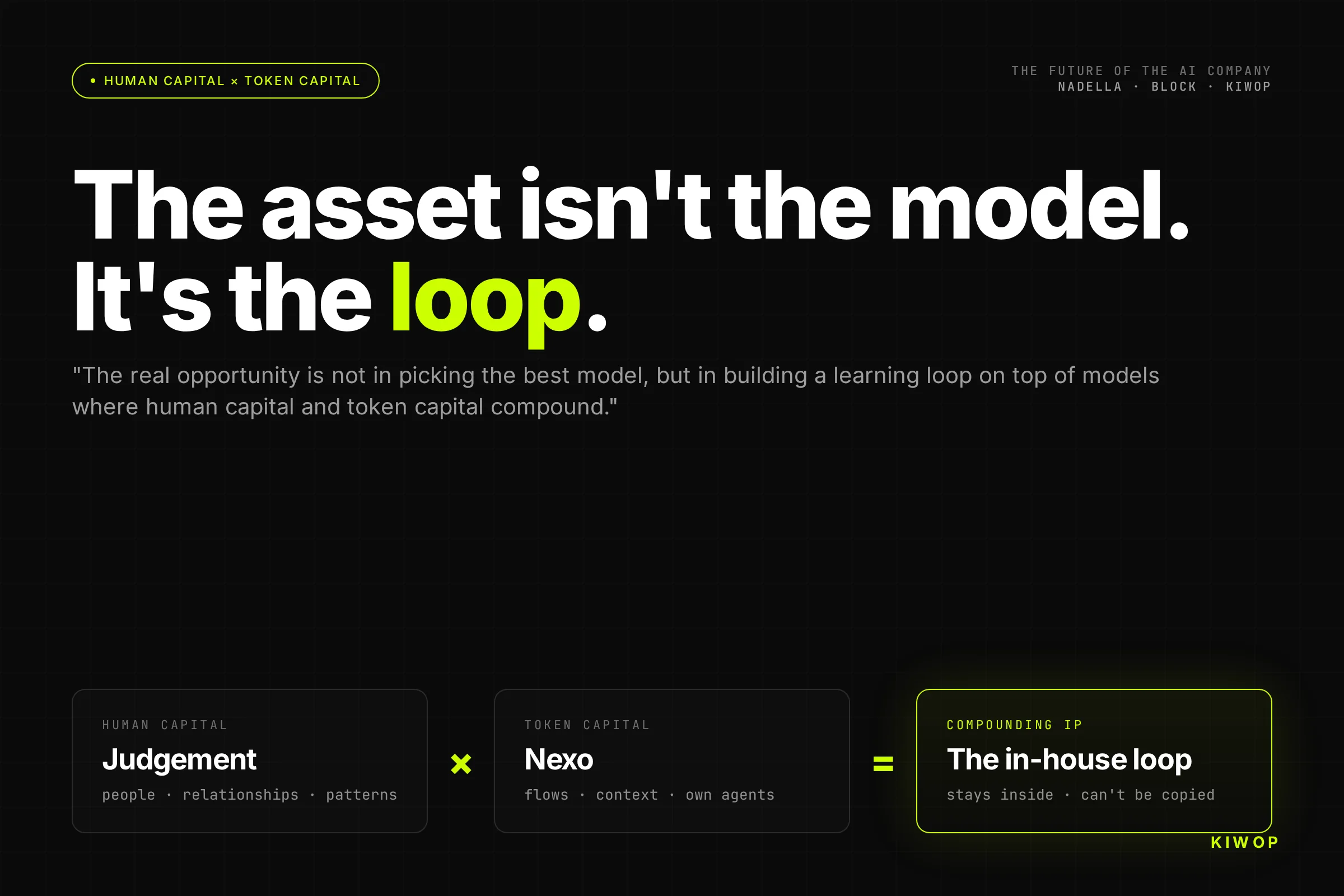
Human capital. The knowledge, judgment, relationships, ingenuity and pattern recognition of the people in a company.
Token capital. The AI capacity a company builds and owns. Not the kind you rent from a vendor, the kind that is yours.
Here is the part almost everyone skips. Human capital does not lose value as token capital grows, it gains value. Nadella says it flatly. Human direction is what makes token capital grow. Without someone to set ambitious goals, connect dots across domains and recognize which patterns matter, all you have is compute spinning in circles.
The conclusion is the important part:
"the real opportunity is not in picking the best model but instead in building a learning loop on top of models where human capital and token capital compound."
And he caps it with the line we liked most. You can delegate a task, even a whole job, but you can never delegate your own learning.
The second signal is Block. On June 17 they announced BuilderBot, an orchestration layer that coordinates several AI agents across their entire codebase, accessible from Slack. You tag a bot, it researches, plans and ships. It picks up tickets from Linear or Jira, opens branches, writes code, raises pull requests and watches CI.
The numbers are the news, not the product. BuilderBot runs more than 200,000 operations a day, merges around 1,500 pull requests a week and already accounts for close to 15% of all code changes that reach production at the company. Work that used to take months now closes in days. And a detail that matters more than it looks: it is built on goose, their open-source agent framework donated to the Linux Foundation's Agentic AI Foundation, and on MCP, the protocol they developed with Anthropic that is now a standard. Brad Axen, their head of AI capabilities, called it "the missing layer between AI coding tools and how engineering actually works at scale."
Microsoft writes it as theory. Block shows it running, with figures. It is the same idea: the value is not in the model, it is in what you build on top.
The gap nobody talks about
There is a problem with both examples. They are giants.
Microsoft has OpenAI inside. Block has hundreds of millions of lines of code, hundreds of services and a team that donates frameworks to the Linux Foundation. It is easy to read Nadella, nod, and assume the "learning loop" happens in another league. That building your own token capital takes being one of the five companies that train models.
It does not, and that is the part we are here to tell.
Kiwop is an agency. Software development, growth marketing and applied AI, with clients across Europe and the United States, operating out of Reus. We do not train models. We do not have hundreds of services. And we have still spent over a year building exactly the loop Nadella describes, scaled to our size. The piece we do it with is Nexo.
If Nadella is right, the interesting thing is not that Microsoft and Block do it. The interesting thing is that an ordinary-sized agency can do it too. Because then it is not the privilege of a few, it is the ecosystem he talks about. And an ecosystem, by definition, reaches the ones below.
What Nexo is
Nexo is the platform Kiwop runs on. From the outside it looks like project management: tasks, hours, clients, deliveries. Inside it is something else. It is where the house judgment stops living in people's heads and loose Slack threads, and becomes a system the team, human and artificial, consults and feeds every day.
We built it for a deeply unglamorous reason: friction. In an agency, every small decision needs someone to interpret it. A commit does not know which pool of hours it belongs to. A task does not know whether it falls under maintenance or a closed project. A judgment call ends up in an email to Josep that gets answered, with luck, tomorrow. None of that is work, it is drag. And drag does not get billed.
Nexo connects to the tool where the work actually happens: each developer's Claude Code. We already covered how nobody at Kiwop writes code by hand anymore. Nexo is the layer that was missing on top of that. Thirteen commands the developer invokes without leaving the terminal, closing the circle between what they do and how the agency runs.
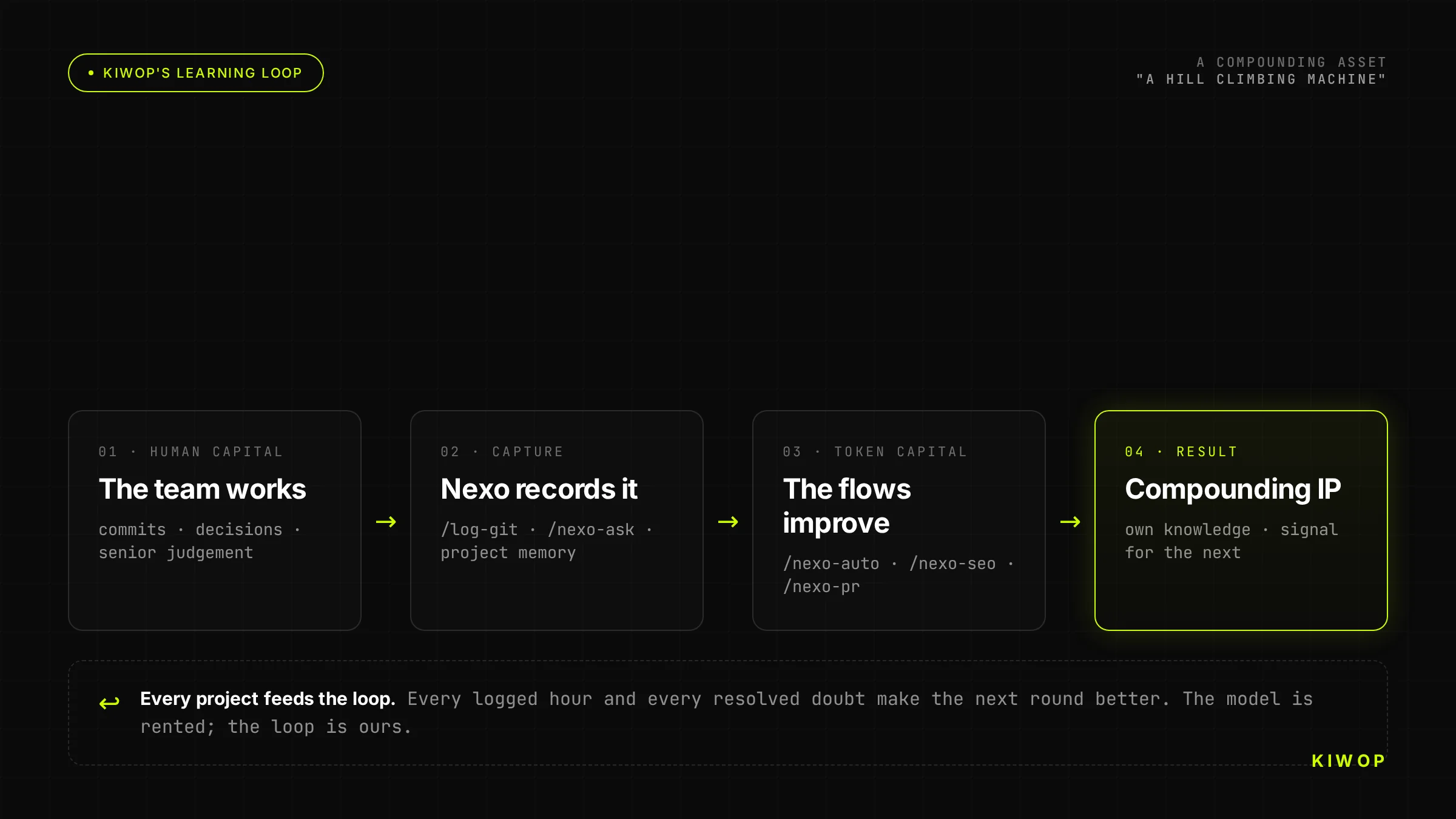
What it does, grouped by what it is for:
It closes the work-to-billing loop. Developers commit. /log-git reads the history, estimates the hours with senior judgment and books them to the right pool, working out on its own whether it is maintenance, a task or a close. Nobody logs hours by hand. The autonomous worker /nexo-auto goes a step further: it pulls safe tasks from the queue, implements them in an isolated worktree, opens the PR, comments to the client and books the hours, with no human in front of it. The agency moves forward while we sleep too.
It centralizes judgment. /nexo-ask is an oracle of the house judgment. The "do these hours go to the pool or is it another project?" question gets asked of the system, not a person. If the system knows, it answers in seconds. If it does not, it escalates to whoever decides, and that answer stays inside for next time. Every question resolved makes the system a little smarter.
It gives capabilities, not reports. /nexo-seo audits a site across its four layers, applies the objective fixes on a branch and leaves what needs a human hand as a task, instead of handing over a PDF nobody rereads. /nexo-staging spins up a standard test environment with one command. /nexo-feedback installs a widget so the client can click any element and have their comment land as a task. /nexo-design kicks off a design with the business context already loaded. /nexo-onboard drops a new developer into a project with a full briefing instead of ten handoffs.
It removes bottlenecks. /nexo-pr carries a change from review to merge without waiting for a human reviewer. /nexo-repo moves repos from personal accounts to the organization. /nexo-unblock clears access on its own or escalates it. /nexo-alert leaves notices that surface to the developer in their context until someone resolves them.
One at a time, they are utilities. Together, they are something else. They are a system that learns. Every hour booked, every question resolved, every task closed by the autonomous worker leaves a trace that improves the next one. This is, literally, what Nadella calls "a hill climbing machine": a machine that climbs the hill and, unlike almost any other asset, compounds.
Why this is Nadella's loop, not one more tool
It is easy to say "we use AI." Everybody says it. The distinction Nadella draws, and the one that matters to us, is between consuming a model and owning a loop. Worth setting the concepts side by side.
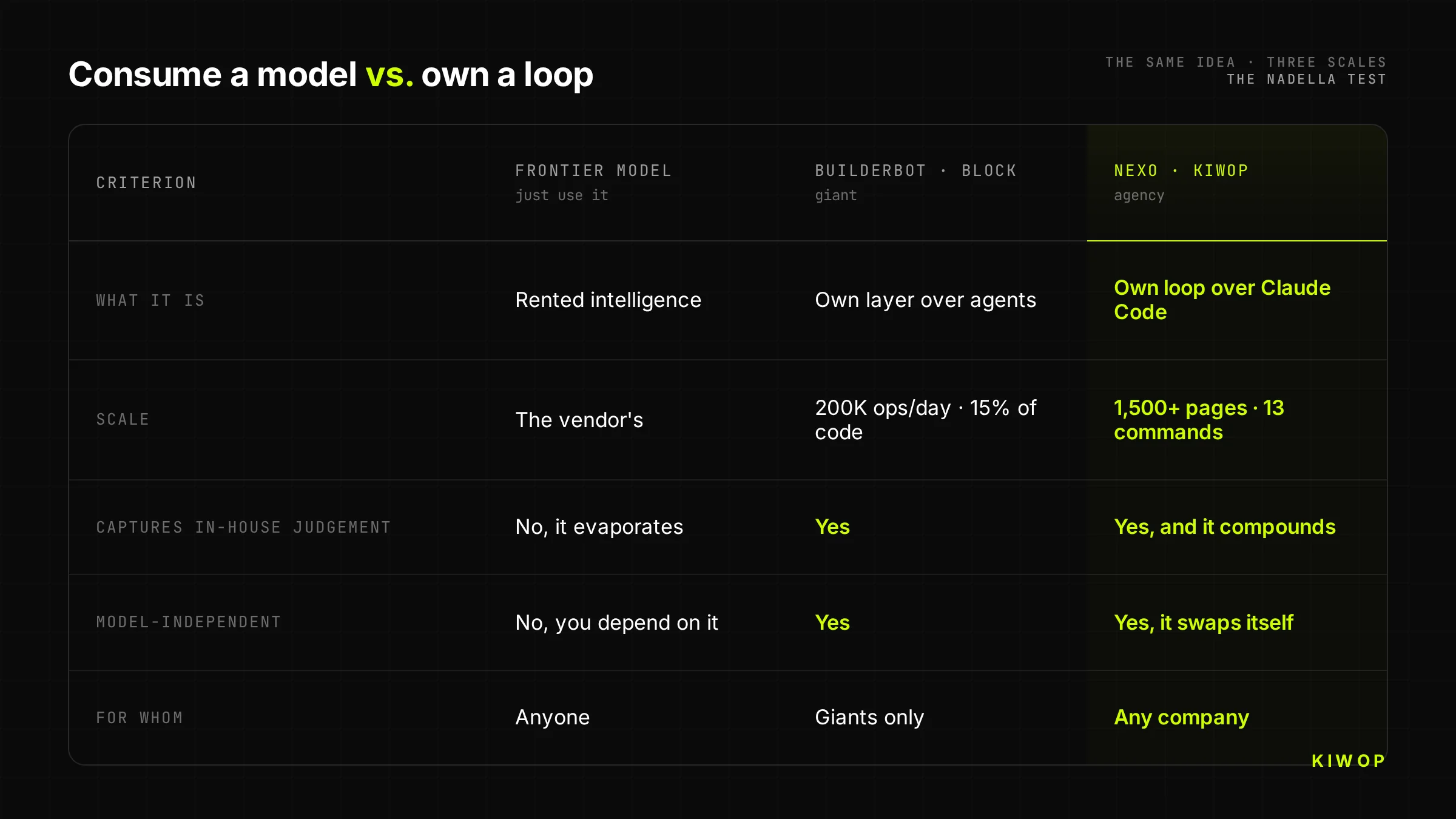
Kiwop's human capital is our seniors' judgment, the relationship with each client, knowing what not to build. The token capital is Nexo: the workflows we have encoded, the decisions we have captured, the worker that executes. And Nadella's key point is that they do not compete. The better Nexo gets, the more the human judgment steering it is worth, because that judgment now applies to more things with less drag. The junior who used to get lost in onboarding now starts with the whole agency behind them. The senior who used to fight administrative fires now spends that time on what only they can do.
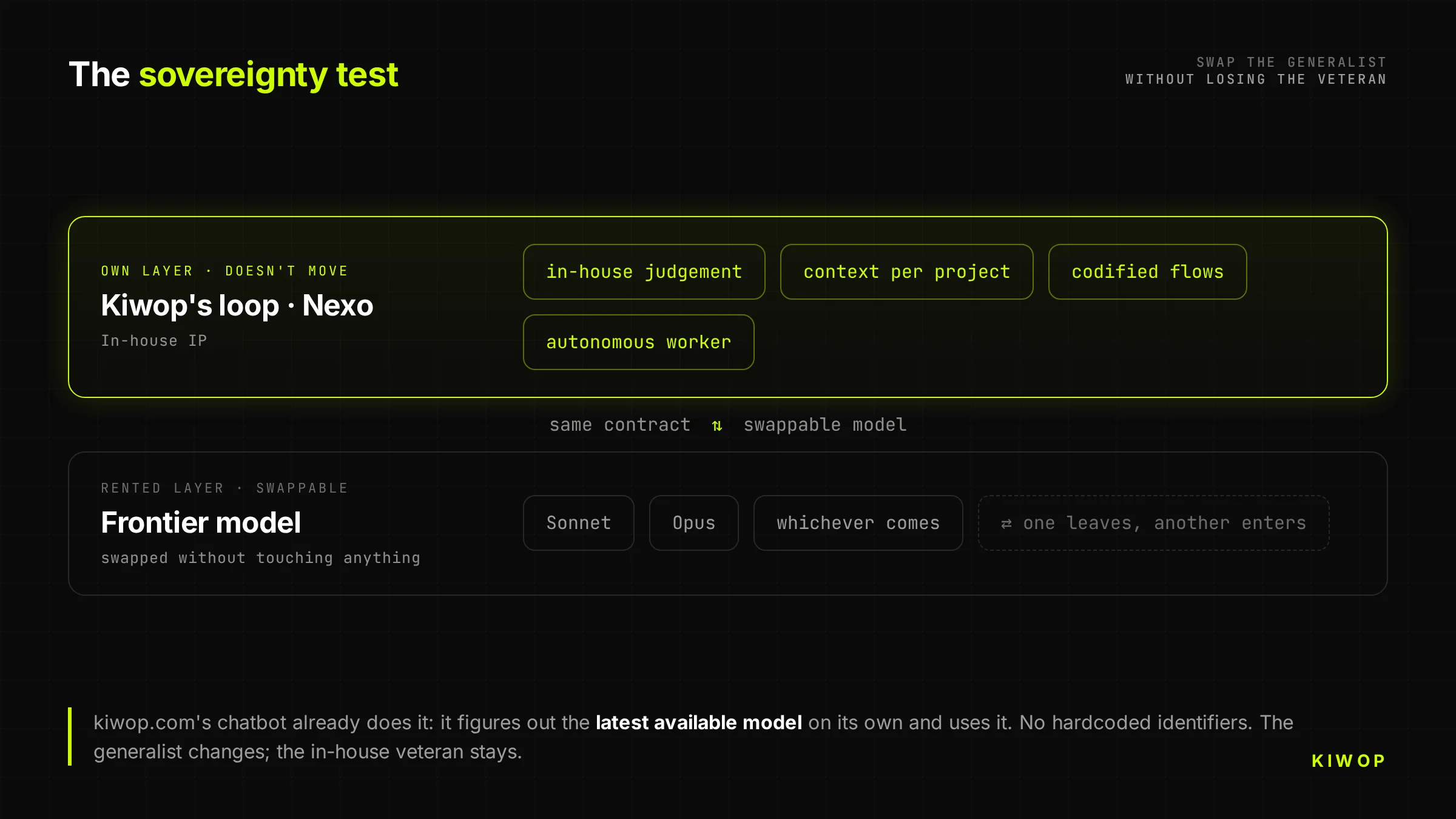
There is a concrete proof, and it is also the "test" Nadella sets for telling whether you truly control your loop or just rent intelligence from a third party. He says a company should be able to swap a "generalist" model without losing the "company veteran" it has built inside its learning system. That is the test of sovereignty in the era ahead.
We already pass it. The kiwop.com chatbot has no model identifier hardcoded anywhere. It works out on its own, in every conversation, which is the latest available Sonnet and uses it. When Anthropic retires a model and ships another, we touch nothing. The model is interchangeable. What does not move is the layer above it: the judgment, the context, the Nexo workflows. The generalist changes, the company veteran stays. That is exactly the test, and we had it solved before we read it.
The same idea, two scales
Let's put the numbers side by side, because they help show it is not a metaphor.
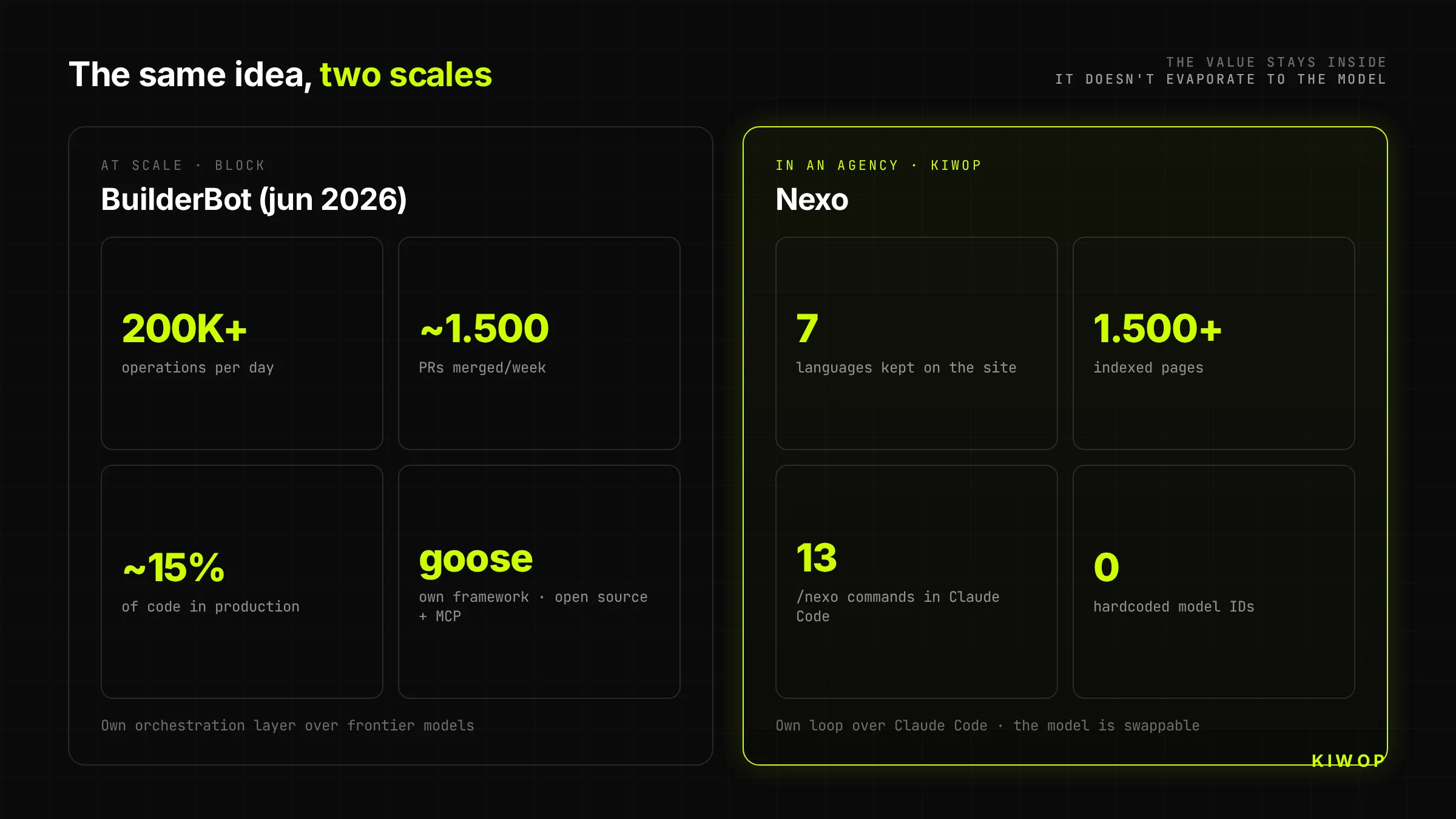
Block runs its loop at a scale that almost makes your head spin: 200,000 operations a day, 1,500 PRs a week, 15% of the code reaching production. We run ours at agency scale: the site you are reading is maintained entirely this way, with more than 1,500 pages indexed across seven languages, and client projects go through the same thirteen commands. We do not compete with Block on volume, nor do we need to. We compete on the same thing they do: keeping the value inside the house instead of letting it evaporate toward whatever model is in fashion.
Because that is the heart of it, and here Nadella gets serious. He warns that the last thing we want is a world where every company in every sector hands its value to a few models that eat everything. He compares it to the first globalization, when entire industrial economies hollowed out through offshoring: the macro numbers looked fine, but the displacement was real and we are still paying for it. His bet, and ours, is to build a frontier ecosystem, not just a frontier model, so value flows toward every company instead of pooling in four places.
For an agency this is not philosophy, it is survival. If all we do is pass prompts to someone else's model, we are a middleman, and middlemen disappear. If we build our own loop that captures our judgment and improves with every project, we have an asset no new model, however good, takes from us. The dependency stops being technological and becomes, once again, methodological. The model is replaceable. The loop is not.
What we are not going to tell you
It would be dishonest to paint this as finished. It is not. The loop only compounds if you feed the system with discipline, and that costs something. There are days when it is faster to resolve a question over Slack and break the chain. The autonomous worker only takes tasks that are unambiguously safe, and deciding what is safe is still human judgment. And the house judgment, the piece Nadella calls human capital, does not capture itself: someone has to do the work of writing it down when the easiest thing is to keep it in their head.
But that is exactly the point. The work of building the loop is real, and that is why it is defensible. If it were free, everyone would have it and it would be worth nothing. What makes it valuable is precisely that it costs, that it compounds, and that after a year you have something nobody replicates by copying a tool.
What this means for your company
If you have read this far you are probably not Microsoft or Block. Good, because that is the point. The learning loop is not a luxury for giants. It is how a company of any size stops handing its value to whatever model is in fashion and starts accumulating its own.
At Kiwop we built it for ourselves first, because we were not going to sell something we did not use every day. Now we build it for clients too: capturing your business judgment, turning your workflows into systems that improve with use, and assembling it so the model underneath is interchangeable and the knowledge is yours. That is AI agent development and LLM integration with judgment, not a demo.
Nadella closes his piece talking about a stable equilibrium: companies that create value for themselves and for the economy around them, employees whose judgment becomes part of systems that make it replicable. We agree. And we think that equilibrium is built from the bottom up, one company at a time. If you want to build yours, let's talk.
Frequently asked questions
What are human capital and token capital?
They are the two central concepts in Satya Nadella's piece on the future of the firm with AI. Human capital is the knowledge, judgment, relationships and pattern recognition of the people in an organization. Token capital is the AI capacity a company builds and owns, not the kind it rents from a vendor. The key idea is that the two compound: the better your token capital, the more valuable the human judgment that steers it becomes.
What is a learning loop in the context of enterprise AI?
It is a system built on top of AI models that captures a company's workflows, domain knowledge and accumulated judgment, and improves with every use. Nadella describes it as a "hill climbing machine": unlike most assets, it compounds, because each improved workflow generates better signal for the next one. The competitive edge is not in the model, which anyone can rent, but in that owned loop that is hard to replicate.
What is Nexo and what does Kiwop use it for?
Nexo is the proprietary platform Kiwop runs on. It connects each developer's Claude Code with running the agency through thirteen commands that automate hour logging, centralize business judgment, deliver specialized capabilities like SEO or staging, and execute tasks autonomously. In practice it is the agency's learning loop: every hour booked, every question resolved and every task closed leaves a trace that improves the next one.
What is Block's BuilderBot?
BuilderBot is the suite of AI tools Block, Jack Dorsey's company, announced on June 17, 2026. It is an orchestration layer that coordinates several AI agents across the company's entire codebase and is used from Slack. It runs more than 200,000 operations a day, merges around 1,500 pull requests a week and accounts for close to 15% of code changes in production. It is built on goose, their open-source agent framework, and on the MCP protocol.
Do you need to be a large company to build an AI learning loop?
No, and that is the argument of this article. The public examples are giants like Microsoft or Block, but the learning loop is a matter of method, not size. Kiwop, an agency operating out of Reus with clients across Europe and the United States, has been running its own for over a year with Nexo. What matters is not scale, but that the company's knowledge stays inside and compounds, instead of handing all the value to whatever model is in fashion.
What does it mean for a learning loop to be model-independent?
It means you can swap the AI model underneath without losing the knowledge you have built on top. Nadella frames it as the sovereignty test of this era: swapping a "generalist" model without losing the "company veteran." The kiwop.com chatbot already meets it. It works out on its own which is the latest available model and uses it, with nothing hardcoded. When the vendor retires a model and ships another, the company's judgment, context and workflows stay intact.